The trick: Headline Over Filing
The paper everyone cites to prove AI is destroying entry-level jobs opens by saying it found no such thing.
A 19% headline number and a "no economy-wide displacement" finding, both in the same study, both getting quoted by opposite sides.
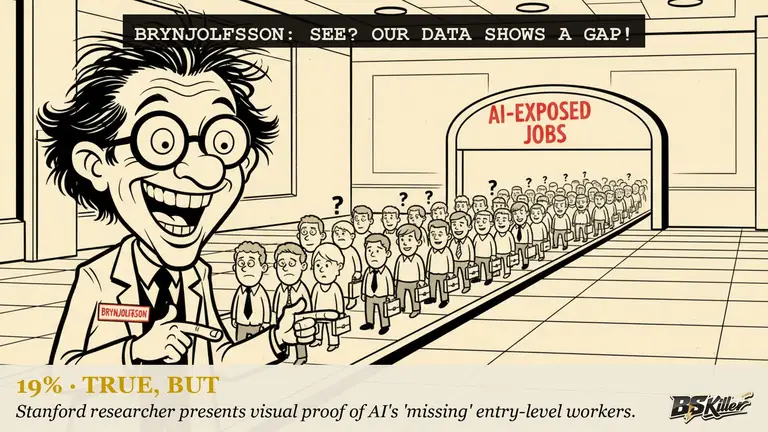
Employment among workers ages 22-25 in highly AI-exposed occupations now stands about 19% below where it would be if it had kept pace with employment among similarly aged workers in less-exposed occupations - cited widely as proof AI has already destroyed a fifth of entry-level jobs.
Before you read on. Your call?
TRUE, BUT
19% gap
A 19% headline number and a "no economy-wide displacement" finding, both in the same study, both getting quoted by opposite sides.
There’s more to this story.
Membership opens the full investigation, the strongest counterargument and what to do with what you’ve learned.
30 days free, then A$89 a year. Payment card required. Cancel before the trial ends to avoid the first charge.
Review my 30-day free trial →- At sign-up: 30 days free. Payment card required. One introductory trial per customer.
- Your trial ends 30 days after you start. Unless you cancel before then in Account → Manage subscription, we charge A$89 for the first year. It renews automatically at A$89/yr until cancelled.
- You can ask for a full refund within 14 days after any annual payment, renewals included, with no reason needed, by emailing hello@bskiller.com. This voluntary refund does not limit your rights under the Australian Consumer Law.
By starting your trial, you agree to the Terms.
BS Killer is published by Inferno Tech Pty Ltd, ABN 27 647 413 474.
Get tomorrow’s check free by email.
Couldn't check your access. That's on us.
The trick has a name
We call it Headline Over Filing: the document underneath says something else. You'll see it again. Learn to spot it →
Receipts
- Context digitaleconomy.stanford.edu:
We do not see widespread, economy-wide job displacement associated with AI.
- Context digitaleconomy.stanford.edu:
The adjustment appears to operate primarily through reduced hiring of young workers rather than increased separations.
- Supports news.outsourceaccelerator.com:
a gap that widened from 15% in July 2025
- Refutes agglomerations.eig.org:
vacancies for the highest AI exposure quintile of occupations peaked in March-April 2022 and declined sharply throughout the remainder of the year.
- Refutes agglomerations.eig.org:
The Fed began its most aggressive cycle of interest rate hikes in forty years in March 2022, precisely when job postings in these sectors began to fall.
- Context brookings.edu:
Early research findings on AI's impact on the labor market are inconclusive, weak signals about the future
- Context it.slashdot.org:
There is still no sign of economy-wide job destruction
Open the Receipts Pack → What each source proves, every figure traced, and what would change our verdict.