The trick: Temporary As Permanent
The EU delayed its AI Act's expensive rules by 16 months and called it cutting red tape.
The cheap disclosure rules stayed on schedule. The costly oversight rules didn't.
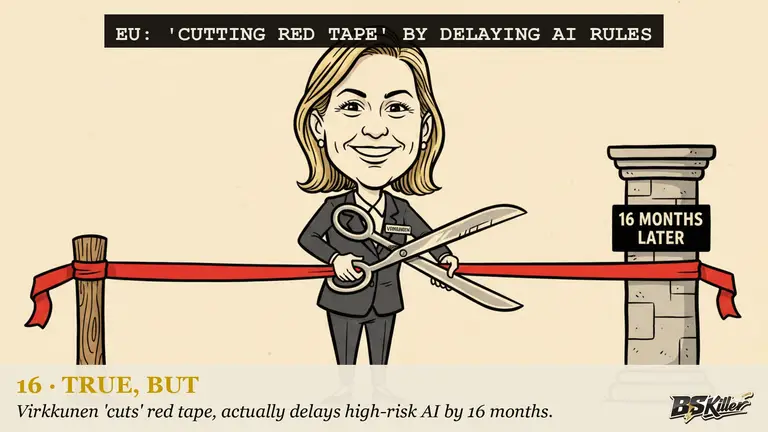
the EU's Digital Omnibus makes 'targeted amendments' to the AI Act, part of a broader push to cut red tape and simplify EU law.
Before you read on. Your call?
TRUE, BUT
16 months
Annex III high-risk system obligations, the expensive ones requiring conformity assessment and oversight infrastructure, moved from August 2026 to December 2027, a 16-month delay. Article 50 chatbot and deepfake disclosure rules, cheap to implement, stayed on the original schedule. Industry associations had lobbied for a delay in this range, citing implementation costs.
The twist
on the same day this issue closes, the European Commission designated ChatGPT a VLOSE under the separate Digital Services Act, citing more than 45 million EU monthly users, showing the enforcement machinery works fine when the obligation is cheap to apply.
There’s more to this story.
Membership opens the full investigation, the strongest counterargument and what to do with what you’ve learned.
30 days free, then A$89 a year. Payment card required. Cancel before the trial ends to avoid the first charge.
Review my 30-day free trial →- At sign-up: 30 days free. Payment card required. One introductory trial per customer.
- Your trial ends 30 days after you start. Unless you cancel before then in Account → Manage subscription, we charge A$89 for the first year. It renews automatically at A$89/yr until cancelled.
- You can ask for a full refund within 14 days after any annual payment, renewals included, with no reason needed, by emailing hello@bskiller.com. This voluntary refund does not limit your rights under the Australian Consumer Law.
By starting your trial, you agree to the Terms.
BS Killer is published by Inferno Tech Pty Ltd, ABN 27 647 413 474.
Get tomorrow’s check free by email.
Couldn't check your access. That's on us.
The trick has a name
We call it Temporary As Permanent: a moratorium or intro price reported as the settled state. You'll see it again. Learn to spot it →
Receipts
- Context digital-strategy.ec.europa.eu:
These services declared that they reach at least 45 million average monthly users in the EU
- Supports gibsondunn.com:
Article 50 transparency obligations for AI systems largely remain on the original schedule
- Supports techpolicy.press:
a large part of high-risk AI systems that have been placed on the market before December 2027 will never have to comply
- Refutes datamatters.sidley.com:
concerns raised by industry and other stakeholders regarding, among other things, delays in the publication of standards and the associated compliance costs
Open the Receipts Pack → What each source proves, every figure traced, and what would change our verdict.