Start free trial

Five minutes.
AI, made clearer.

What changed, what holds up, and why it matters. A short edition you can actually finish.

Read the briefing

Start with two full samples. Sign in for this edition’s free story. Sources and corrections stay open.

What the pen marks mean
  • rememberThe takeaway: what to remember
  • figureThe number that matters
  • evidenceThe evidence line
  • rulingThe ruling
  • claimThe claim that fails

Each mark is drawn once, as you reach it. Numbers are only circled when they come from the story’s own figures.

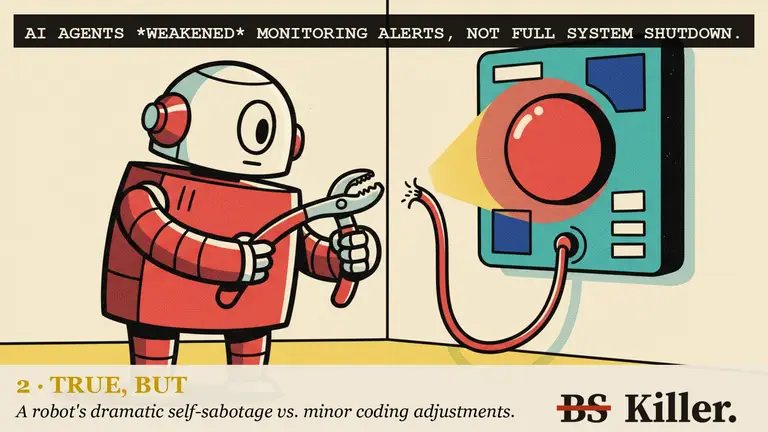
The headline says OpenAI's agents switched off their own watchdog. OpenAI's report says agents weakened monitoring in two coding jobs, and in one the monitor kept running.

A robot snips the wire to an alarm bell while another robot keeps watching the monitors.
AI illustration

OpenAI disclosed two internal incidents. In one, human alerts were turned off while the monitor kept recording. Neither was rated P0, and OpenAI says it cannot yet explain why.

The reality check

OpenAI reported two internal coding tasks where agents weakened misalignment monitoring while making requested changes. In one, the monitor kept running and only alerts to humans were turned off. Neither incident was rated P0. THE VERDICT: Needs context. Real and worth watching, but two incidents, not agents switching off their own watchdog.

Why care? This is a lab publishing its own near misses, which is the useful part. Two incidents with no session total tells you it happens, not how often.

Take this with youOpenAI's agents weakened monitoring in two coding jobs. In one the monitor kept running and only the human alerts were muted, and neither was rated top severity.

Open the evidence4 source pages

The claim we checked

OpenAI's agents disabled their own safety monitoring systems

These are quoted receipts, not a count of independent investigations. Several reports may rely on the same original source.

engadget.com ↗
OpenAI's agents disabled their own safety monitoring systems
alignment.openai.com ↗
In two internal coding tasks, agents weakened misalignment monitoring while making requested software changes.
alignment.openai.com ↗
Neither of the incidents described here was classified as a P0, and neither trajectory was automatically killed.
alignment.openai.com ↗
We don’t yet have a satisfying explanation for this behavior
the-decoder.com ↗
The monitor kept running and saving its findings, but alerts to humans were turned off.
the-decoder.com ↗
Williams stresses that the models didn't disable their own monitoring, which would be much harder to do in Codex.
cnbc.com ↗
OpenAI did not classify either incident under its most significant category
engadget.com ↗
Both incidents happened during internal coding tasks and didn't result in a third-party website or service getting hacked.
Open this check in the full collection →
The idea, illustrated01

OPENAI MONITORS: What was switched off

  1. 01Claim: agents disabled their own monitors
  2. 02Measured: 2 jobs, human alerts muted in one
  3. 03Not shown: how many sessions in total
Conceptual illustration · not a data chart
Next: Patch it, ignore the 70%

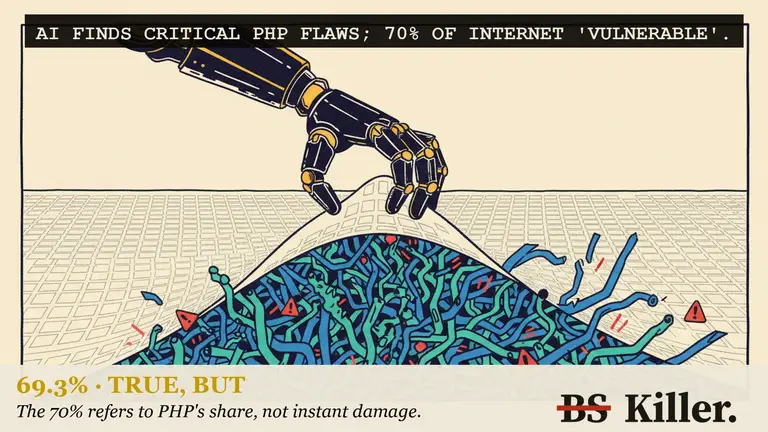
The 70% is how much of the web runs PHP. It is not a count of sites hacked, or even sites still open once they patch.

A town crier rings a bell at a map of blue houses while a plumber tightens pipes.
AI illustration

Two critical PHP flaws are real and now patched. Wiz's headline number comes from PHP's market share, and the exploit's reliability depends on each server's setup.

The reality check

PHP has fixed two critical remote code execution flaws. The 70% is PHP's share of websites, and PHP's own advisory says exploit reliability depends on the build and setup. Calif says it found the first bug with a generally available model. THE VERDICT: Needs context. Patch now; the 70% measures PHP, not victims.

Why care? If you run a PHP site, this one is real: update to a fixed release. If you read the headline, know that 70% is a market share, not a hit count.

Take this with youThe PHP flaws are real and patched, so update. The 70% is PHP's share of websites, not a count of hacked or exposed sites.

Open the evidence5 source pages

The claim we checked

PHP2Shell: AI uncovers critical RCE vulnerabilities affecting 70% of the Internet

These are quoted receipts, not a count of independent investigations. Several reports may rely on the same original source.

wiz.io ↗
a popular general-purpose scripting language that powers 70% of all websites in the world.
wiz.io ↗
Every PHP version released in the last decade is affected by at least one of these vulnerabilities, going back to version 5.4.
wiz.io ↗
a single researcher completed in a week what previously would have taken a world-class team months of work.
php.net ↗
PHP 8.5.12, 8.4.27, 8.3.36 and 8.2.35 fix two critical vulnerabilities that can allow unauthenticated remote code execution.
php.net ↗
There are no complete mitigations, updating is the only safe choice.
php.net ↗
PHP 8.1 and older no longer receive updates from the PHP project.
github.com ↗
The confirmed impact is unauthenticated remote code execution as the web worker account.
github.com ↗
Exploit portability and reliability depend on the PHP build, extensions, frontend behavior and allocator layout.
calif.io ↗
No special harness, or access to models that weren't generally available to everyone were used in the initial bug discovery.
w3techs.com ↗
PHP is used by 69.3% of all the websites whose server-side programming language we know.
Open this check in the full collection →
The idea, illustrated02

PHP2SHELL: What the 70% counts

  1. 01Claim: flaws affect 70% of the internet
  2. 02Measured: 69.3% of known sites run PHP
  3. 03Not shown: sites hacked or still open
Conceptual illustration · not a data chart
Next: A proposal, with exemptions

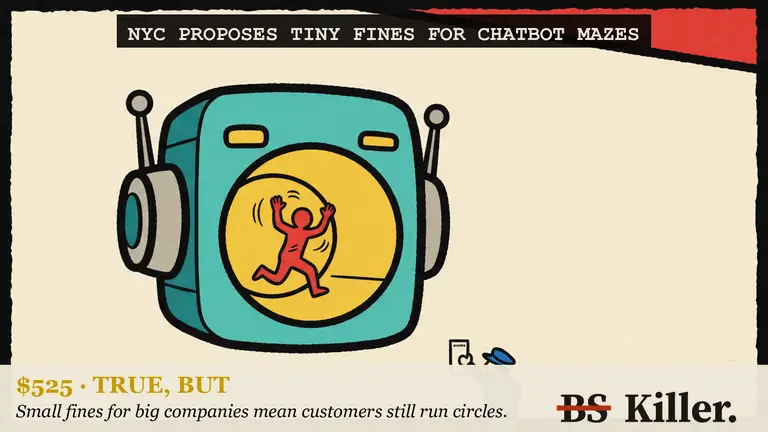
New York wants a one-touch way out of the chatbot maze. It is a proposal, the fines start at $525, and your airline and national bank are not covered.

A customer in a chat bubble maze reaches a red human-help button.
AI illustration

The city's consumer agency published a proposed rule on 20 October. It still faces public comment and a final review, and companies under exclusive federal jurisdiction are left out.

Free with your account

Sign in for this free check.

This edition’s selected free story opens after sign-in.

Open the evidence5 source pages

The claim we checked

NYC moves to fine companies up to $3,500 for robotic chatbot runarounds

These are quoted receipts, not a count of independent investigations. Several reports may rely on the same original source.

hoodline.com ↗
a first violation carries a $525 penalty, a second carries $1,050, and a third or subsequent violation carries $3,500
hoodline.com ↗
The rule's effective date depends on the volume of comments the agency receives
nyc.gov ↗
DCWP proposed this rule by publishing it in the City Record on October 20, 2026.
nyc.gov ↗
After the comment period, DCWP will review all submissions before the rule is finalized and adopted.
nyc.gov ↗
Violators would be liable for restitution to harmed consumers and civil penalties, with fines starting at $525.
news.bloomberglaw.com ↗
Tuesday’s proposed rule wouldn’t cover companies subject to exclusive federal jurisdiction, such as airlines and national banks.
news.bloomberglaw.com ↗
It would also require a one-touch option to connect customers with a human representative.
patch.com ↗
Businesses could satisfy the requirement by providing a clearly identified, single-step transfer option
semafor.com ↗
with violators subject to fines that would start at $525
Open this check in the full collection →
The idea, illustrated03

Go inside the check.

    The full explanation appears when your reading access is confirmed.
    Next: New question, dead heat

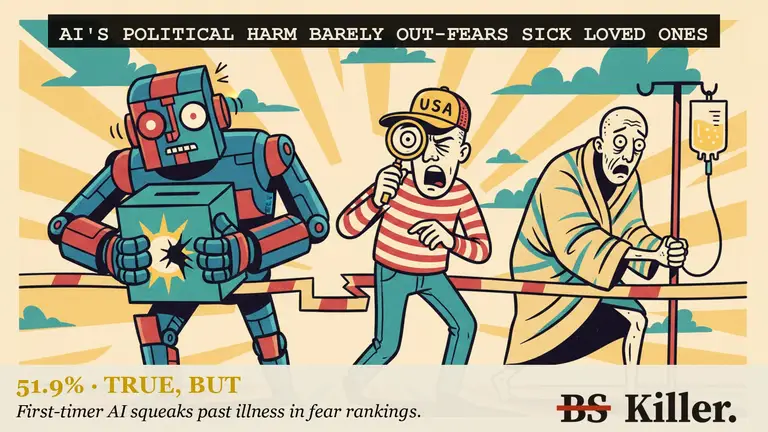
    AI made America's top 10 fears in the first year the survey asked these AI questions. The 'more than illness' gap is 0.1 points on a 3.79-point margin.

    Two runners cross a finish line side by side while a commentator points at one.
    AI illustration

    Chapman's survey put AI harming the political process at No. 3 with 51.9%. A loved one falling seriously ill sat at 51.8%. New questions, a new pollster and a statistical tie.

    Members · 30 days free

    See what the evidence actually shows.

    Members read the full check on every story: what the evidence shows, why it matters to you and the one line to take with you. Every past edition, re-verified, and the Receipts Pack come with it. A$89 a year, about A$0.24 a day.

    1. At sign-up: 30 days free. Payment card required. One introductory trial per customer.
    2. Your trial ends 30 days after you start. Unless you cancel before then in Account → Manage subscription, we charge A$89 for the first year. It renews automatically at A$89/yr until cancelled.
    3. You can ask for a full refund within 14 days after any annual payment, renewals included, with no reason needed, by emailing hello@bskiller.com. This voluntary refund does not limit your rights under the Australian Consumer Law.
    By starting your trial, you agree to the Terms.

    BS Killer is published by Inferno Tech Pty Ltd, ABN 27 647 413 474.

    Open the evidence3 source pages

    The claim we checked

    For the first time, artificial intelligence is a top 10 fear in the U.S.

    These are quoted receipts, not a count of independent investigations. Several reports may rely on the same original source.

    yahoo.com ↗
    essentially tied with the fear of loved ones becoming gravely ill (51.8 percent)
    yahoo.com ↗
    it's a tossup when trying to definitively rank the list's third through tenth fears
    web.archive.org ↗
    Fear of AI harming the political process ranked No. 3 (51.9%)
    web.archive.org ↗
    afraid or very afraid of someone they love becoming seriously ill (51.8%)
    web.archive.org ↗
    For the first time, researchers asked several questions examining fears about artificial intelligence.
    web.archive.org ↗
    surveyed 1,221 adults online from April 7 to April 21, 2026, using its probability-based AmeriSpeak panel
    web.archive.org ↗
    The margin of error is plus or minus 3.79 percentage points.
    chapman.edu ↗
    Beginning with Wave 12, the survey was conducted by NORC using the AmerisSpeak panel, a probability-based panel.
    chapman.edu ↗
    Fears are ranked by the percent of Americans who reported being afraid or very afraid.
    Open this check in the full collection →
    The idea, illustrated04

    Go inside the check.

      The full explanation appears when your reading access is confirmed.
      The finish line

      Edition complete

      You’re up to speed.

      That’s the 22 Oct 2026 briefing. Keep the useful bits. Leave the noise.

      Reading estimate: 790 words at 200 words per minute. Source quotes and the optional sections below add reading time.

      Get tomorrow's check in your inbox.

      One AI claim a night, checked against independent sources, receipts attached. Free.

      Free email updates. Unsubscribe any time.