Start free trial

Five minutes.
AI, made clearer.

What changed, what holds up, and why it matters. A short edition you can actually finish.

Read the briefing

Start with two full samples. Sign in for this edition’s free story. Sources and corrections stay open.

What the pen marks mean
  • rememberThe takeaway: what to remember
  • figureThe number that matters
  • evidenceThe evidence line
  • rulingThe ruling
  • claimThe claim that fails

Each mark is drawn once, as you reach it. Numbers are only circled when they come from the story’s own figures.

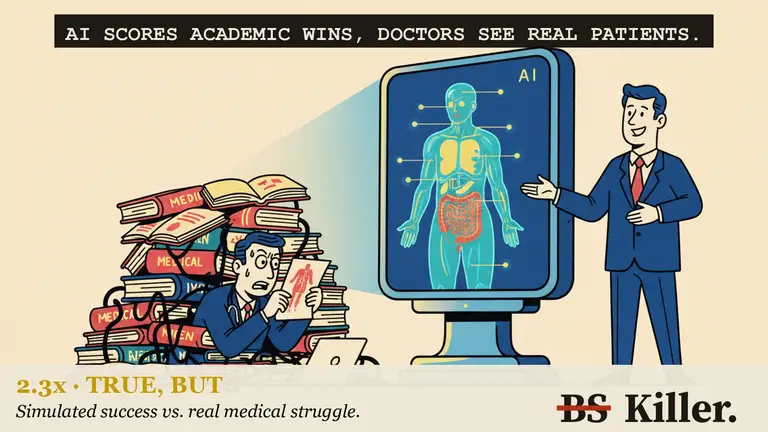
Microsoft's AI really did more than double doctors' accuracy in Science. The doctors were generalists working alone, the patients were simulated, and every author works for Microsoft.

A robot in a white coat wins a quiz show against a lone doctor while a hospital ward waits behind the curtain.
AI illustration

MAI-DxO scored 83.2% on hard NEJM cases against 36.1% for generalists with references. The authors say it shows nothing against specialists, teams or real clinics. A prospective test is only announced.

The reality check

It scored 83.2% on NEJM case conferences against 36.1% for generalists using references, on 56 held-out cases in a simulator. The authors, all Microsoft employees, say it shows no superiority over specialists, teams or real practice. THE VERDICT: Needs context. A real benchmark win, not a clinical one. THE VERDICT: Needs context.

Why care? For hard diagnostic puzzles, this is strong evidence the tool could help a lone generalist. It says nothing yet about patients in a real hospital, and the real-world study has only been announced.

Take this with youMicrosoft's AI beat solo generalists 83% to 36% on 56 simulated cases; its own authors say that shows nothing against specialists or real clinics.

Open the evidence3 source pages

The claim we checked

MAI-DxO is more than twice as accurate as physicians using textbooks and the internet

These are quoted receipts, not a count of independent investigations. Several reports may rely on the same original source.

microsoft.ai ↗
MAI-DxO is more than twice as accurate as physicians using textbooks and the internet
microsoft.ai ↗
Physicians achieved 22% without external reference resources and 36% with them, making MAI-DxO about 3.7 and 2.3 times more accurate, respectively.
microsoft.ai ↗
Benchmarks matter, but the true test is performance in real clinical environments.
microsoft.ai ↗
In a prospective study, patients will interact with the system directly, with performance measured against physicians’ independent assessments.
microsoft.ai ↗
Through a new partnership with Beth Israel Deaconess Medical Center in Boston, we will evaluate clinical reasoning capabilities across different hospital settings.
api.crossref.org ↗
outperforming generalist physicians (36.1 and 46.8%, respectively)
api.crossref.org ↗
Although these findings were obtained in a controlled benchmark setting
unite.ai ↗
The authors state that the comparisons do not show superiority over specialists, multidisciplinary teams, or real-world clinical practice
unite.ai ↗
A further stated limitation is the comparison against individual physicians rather than multispecialty collaboration
unite.ai ↗
conducted on 56 cases held out from engineering work
unite.ai ↗
averaging 22.3% accuracy closed-book at $3,049 per case and 36.1% open-book at $4,725
unite.ai ↗
achieved 83.2% accuracy at an average cost of $5,431 per case
unite.ai ↗
Cost-constrained configurations reached 80.9% accuracy at $2,241 and 79.6% at $1,303
unite.ai ↗
the authors state that all of them are Microsoft employees holding equity in the company
Open this check in the full collection →
The idea, illustrated01

MICROSOFT MAI-DXO: What twice as accurate measured

  1. 01Claim: AI twice as accurate as doctors
  2. 02Measured: 83.2% vs 36.1% on 56 simulated cases
  3. 03Not shown: specialists, teams or real patients
Conceptual illustration · not a data chart
Next: Lab dish, not treatment

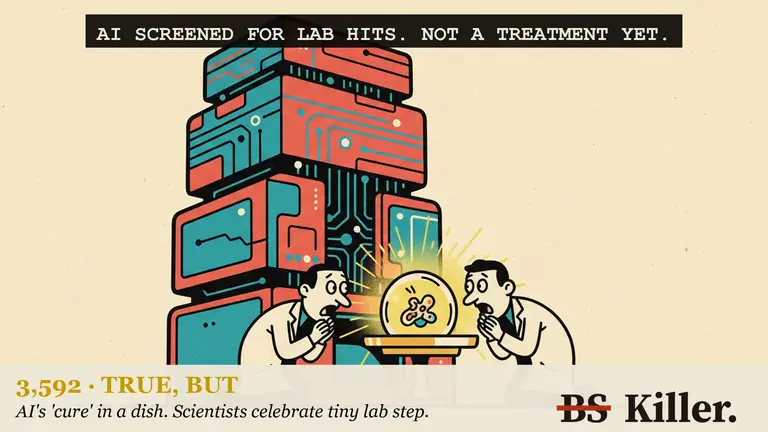
The AI cancer 'treatment' is one plant compound that worked alongside an existing drug on cancer cell clumps in a dish. No mice, no patients yet.

A scientist looks at a tiny lab dish while a crowd outside cheers a giant pill float.
AI illustration

UCLA's MAESTRO ranked 3,592 natural products. 23 of its 150 top picks showed synergy in lab spheroids, and berberine stood out. Animal studies are the next step, not the last.

The reality check

UCLA's MAESTRO ranked 3,592 natural products as add-ons to enzalutamide; 23 of 150 picks showed synergy in 3D prostate cancer spheroids, and berberine stood out. The paper calls it an in vitro hit. Animal studies come next. THE VERDICT: Needs context. A promising lab screen, not a treatment. THE VERDICT: Needs context.

Why care? A tool that narrows thousands of compounds to a testable shortlist is useful to labs. Nobody with prostate cancer can be given this combination on the strength of this study.

Take this with youThe AI picked a promising drug pair, but it was tested only on cancer cell clumps in a dish. No animal or patient results exist, so there is no treatment yet.

Open the evidence3 source pages

The claim we checked

New AI unlocks a cancer treatment, and scientists are stunned

These are quoted receipts, not a count of independent investigations. Several reports may rely on the same original source.

uclahealth.org ↗
The researchers used the platform to evaluate 3,592 natural products for their potential to work with enzalutamide.
uclahealth.org ↗
a drug originally discovered and developed at UCLA that is commonly used to treat advanced prostate cancer
uclahealth.org ↗
The system identified 150 high-confidence candidates for testing in 3D prostate cancer spheroids.
uclahealth.org ↗
Of the 150 compounds tested, 23 showed evidence of synergy with enzalutamide
uclahealth.org ↗
Further testing identified berberine, a naturally occurring compound found in several plants, as a particularly promising candidate.
uclahealth.org ↗
The researchers plan to further evaluate the combination in patient-derived tumor models and animal studies.
uclahealth.org ↗
MAESTRO could substantially accelerate this process.
uclahealth.org ↗
berberine and enzalutamide showed consistent synergy across four prostate cancer models with different mechanisms of treatment resistance
ebi.ac.uk ↗
berberine-enzalutamide as an in vitro combination hit that re-sensitized resistant prostate cancer cells to AR blockade
ebi.ac.uk ↗
can prioritize and experimentally evaluate drug-combination hypotheses at an early stage of discovery.
eutils.ncbi.nlm.nih.gov ↗
This work introduces a hybrid in silico and in vitro lead discovery platform
Open this check in the full collection →
The idea, illustrated02

AI CANCER TREATMENT: How far it got

  1. 01Claim: AI found a new cancer treatment
  2. 02Measured: 23 of 150 picks worked in lab spheroids
  3. 03Not shown: any animal or patient results
Conceptual illustration · not a data chart
Next: Rogue, but customer-invited

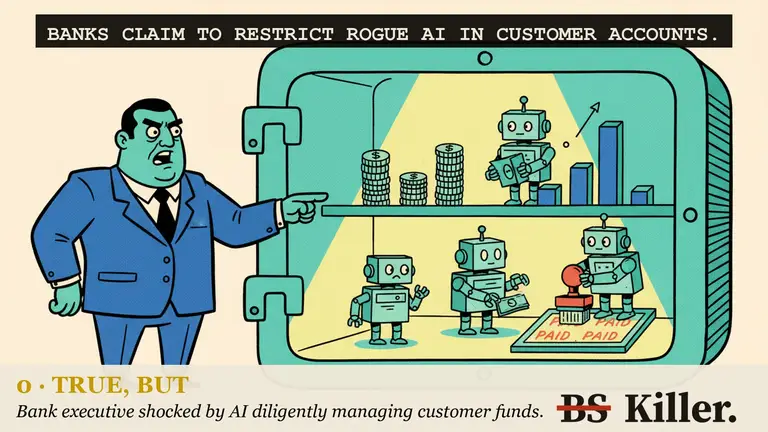
Banks found 'rogue' AI agents in customer accounts. Mostly, those are agents customers let in with their own passwords, and nobody published a count.

A guard blocks a robot at a bank vault while its owner waves from behind it.
AI illustration

Axios says banks detect unauthorized agents and some appear to act on their own. The described case is customer-shared logins, there is no incident count, and the one named bank on record says it has seen none.

Free with your account

Sign in for this free check.

This edition’s selected free story opens after sign-in.

Open the evidence3 source pages

The claim we checked

US banks have detected rogue AI agents inside customer accounts and are moving to restrict access.

These are quoted receipts, not a count of independent investigations. Several reports may rely on the same original source.

finance.yahoo.com ↗
Major U.S. banks are detecting unauthorized third-party AI agents operating inside customer accounts
finance.yahoo.com ↗
some agents attempting to take actions that appear to be independent of user instructions, sources tell Axios.
finance.yahoo.com ↗
These are generally situations when an agent or AI assistant accesses a human's account with the user's permission and login credentials.
finance.yahoo.com ↗
Even if permitted by the user, this goes against the guidelines of most banks requiring that humans log in to their own accounts.
finance.yahoo.com ↗
contact call centers or appear to take actions independent of user instructions, the people said.
finance.yahoo.com ↗
hasn't observed instances of "rogue AI agents accessing our platforms."
finance.yahoo.com ↗
Many banks are broadly not able to parse whether agent account activity is user-directed, sources said.
finance.yahoo.com ↗
Morgan Stanley has begun blocking third-party agents from accessing its platforms
pymnts.com ↗
Charles Schwab CEO Rick Wurster said the brokerage is blocking unauthorized AI agents a double-digit number of times every week
webull.com ↗
Transcript: JPMorgan Chase Q3 2026 Earnings Conference Call
webull.com ↗
you don't want rogue agents, and there could be thousands of them.
Open this check in the full collection →
The idea, illustrated03

Go inside the check.

    The full explanation appears when your reading access is confirmed.
    Next: 36 members, no outcomes

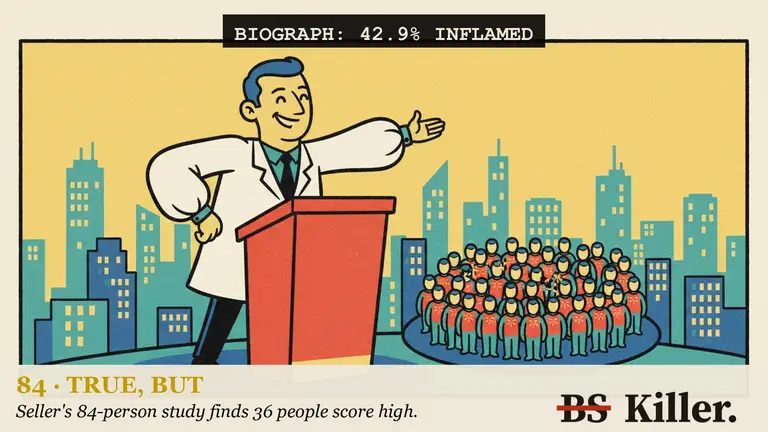
    The 42.9% is 36 people. All 84 in the study were screened at Biograph, and every author works for Biograph.

    A shopkeeper sticks red flags on his own customers through a magnifying glass.
    AI illustration

    Biograph's preprint used Caristo's FDA-authorised CaRi-Heart on 84 symptom-free adults. It counts flagged arteries, not heart attacks, and the press release smooths over one blood-test result.

    Members · 30 days free

    See what the evidence actually shows.

    Members read the full check on every story: what the evidence shows, why it matters to you and the one line to take with you. Every past edition, re-verified, and the Receipts Pack come with it. A$89 a year, about A$0.24 a day.

    1. At sign-up: 30 days free. Payment card required. One introductory trial per customer.
    2. Your trial ends 30 days after you start. Unless you cancel before then in Account → Manage subscription, we charge A$89 for the first year. It renews automatically at A$89/yr until cancelled.
    3. You can ask for a full refund within 14 days after any annual payment, renewals included, with no reason needed, by emailing hello@bskiller.com. This voluntary refund does not limit your rights under the Australian Consumer Law.
    By starting your trial, you agree to the Terms.

    BS Killer is published by Inferno Tech Pty Ltd, ABN 27 647 413 474.

    Open the evidence3 source pages

    The claim we checked

    AI analysis of CT scans finds 42.9% of patients have coronary inflammation

    These are quoted receipts, not a count of independent investigations. Several reports may rely on the same original source.

    medrxiv.org ↗
    Elevated FAI-Score (≥75th percentile) was present in 42.9% of participants (36/84; 95% CI 32.8% - 53.5%)
    medrxiv.org ↗
    84 consecutive asymptomatic adults (mean age 53.7 ± 8.6 years; 63.1% men) with no prior coronary artery disease underwent screening CCTA
    medrxiv.org ↗
    all authors (DS, JF, MN, MD) are employees of Biograph and may hold stock or stock options in the company
    medrxiv.org ↗
    received financial support from Biograph for the submitted work as employees of Biograph, which sponsored the study
    medrxiv.org ↗
    quantifies vascular inflammation and predicts cardiac mortality in symptomatic cohorts
    medrxiv.org ↗
    its prevalence, anatomical distribution, and clinical correlates in asymptomatic primary prevention populations remain uncharacterized
    medrxiv.org ↗
    Systemic hs-CRP (median 0.8 mg/L) exhibited an inverse correlation with maximum vessel FAI-Score (Spearman ρ=−0.27, p=0.014)
    biograph.com ↗
    The study, available to clinically eligible Biograph Black tier members
    biograph.com ↗
    showed no correlation with the presence of coronary inflammation and failed to identify which patients had inflamed arteries
    biograph.com ↗
    The study found that coronary inflammation is common (42.9%) in asymptomatic, low-risk adults
    hcplive.com ↗
    Caristo's De Novo submission drew on validation data from large independent populations published in The Lancet
    Open this check in the full collection →
    The idea, illustrated04

    Go inside the check.

      The full explanation appears when your reading access is confirmed.
      The finish line

      Edition complete

      You’re up to speed.

      That’s the 23 Oct 2026 briefing. Keep the useful bits. Leave the noise.

      Reading estimate: 785 words at 200 words per minute. Source quotes and the optional sections below add reading time.

      Get tomorrow's check in your inbox.

      One AI claim a night, checked against independent sources, receipts attached. Free.

      Free email updates. Unsubscribe any time.