Start with two full samples. Sign in for this edition’s free story. Sources and corrections stay open.
What the pen marks mean
rememberThe takeaway: what to remember
figureThe number that matters
evidenceThe evidence line
rulingThe ruling
claimThe claim that fails
Each mark is drawn once, as you reach it. Numbers are only circled when they come from the story’s own figures.
01 / MoneyTrue, butFree sample
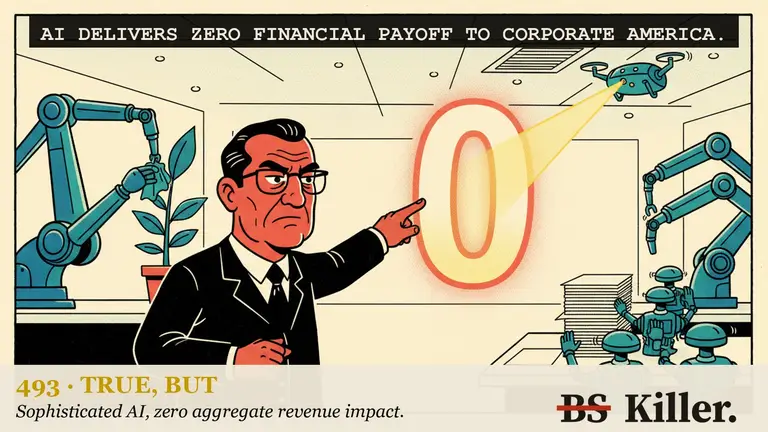
Apollo's chief economist says AI has delivered zero payoff outside tech. His charts show flat averages for 493 companies. Flat on average is not zero for everyone.
Torsten Slok, Apollo chief economist, The Daily Spark (24 October 2026); trending on Hacker News, 24 October 2026 ·
AI illustration
Revenue per worker and margins are flat for the S&P 493, and productivity growth is near nil. That supports 'no visible payoff yet'. It does not measure AI, and an Atlanta Fed survey finds small positive gains that lag in the revenue numbers.
The reality check
Apollo's charts show revenue per worker and margins flat for the S&P 493 and productivity growth near nil. Other data agree nothing shows up yet in the aggregates. But the charts are averages that do not separate AI from anything else, and an Atlanta Fed survey of executives finds positive gains that are slow to reach revenue. THE VERDICT: Needs context. 'Not visible yet' holds. 'Zero' overreaches.
Why care? If you are deciding on AI spend, the honest read is that broad payoffs have not shown up in big-company averages yet. That is a reason to measure your own results, not proof there are none.
Take this with youApollo's charts show flat revenue per worker and margins for the S&P 493. That fits no visible payoff yet, but the charts do not measure AI itself.
Open the evidence3 source pages +
The claim we checked
Despite massive investment, AI has delivered zero financial payoff to corporate America outside of tech.
These are quoted receipts, not a count of independent investigations. Several reports may rely on the same original source.
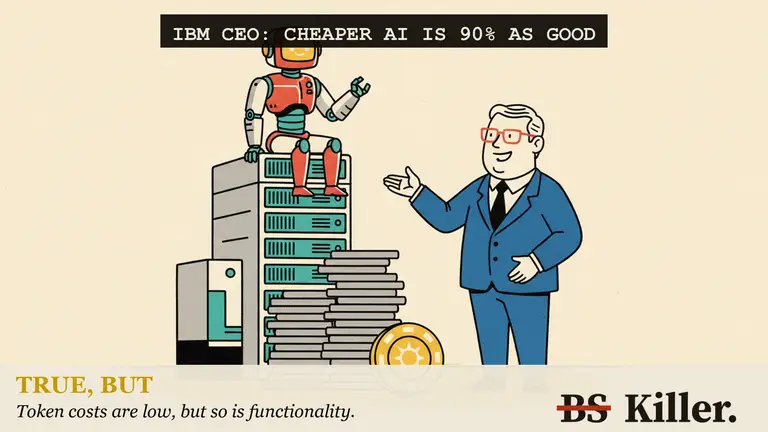
IBM's CEO says open weights are 90% as good for 10% of the cost. In Ramp's spending data, only 6.4% of AI-spending businesses pay for open-source models.
IBM CEO Arvind Krishna, IBM third quarter 2026 earnings call (21 October 2026); trending on r/artificial ·
AI illustration
The cost pressure is real. But spending data says most of the shift goes to cheaper closed models, the 90% has no named benchmark, and IBM sells the racks.
The reality check
a survey shows open-weight token share rising to 34%, but Ramp's spending data says most growth goes to cheaper closed models and only 6.4% of AI-spending businesses pay for open-source ones. No benchmark is named for the 90%, and IBM sells the on-premises racks. THE VERDICT: Needs context. Cheaper models are winning; open weights are one slice.
Why care? The saving is real but comes mostly from smaller models, which closed vendors also sell. Before buying 2 or 3 racks, price a small closed tier against an open model on your own work.
Take this with youIBM's CEO says firms are choosing open-weight models. In Ramp's spending data only 6.4% of AI-spending businesses pay for open-source models, and IBM sells the racks.
Open the evidence6 source pages +
The claim we checked
Businesses are choosing open-weight AI models over expensive frontier models, which are now 90% as good at 10% to 25% of the token cost.
These are quoted receipts, not a count of independent investigations. Several reports may rely on the same original source.
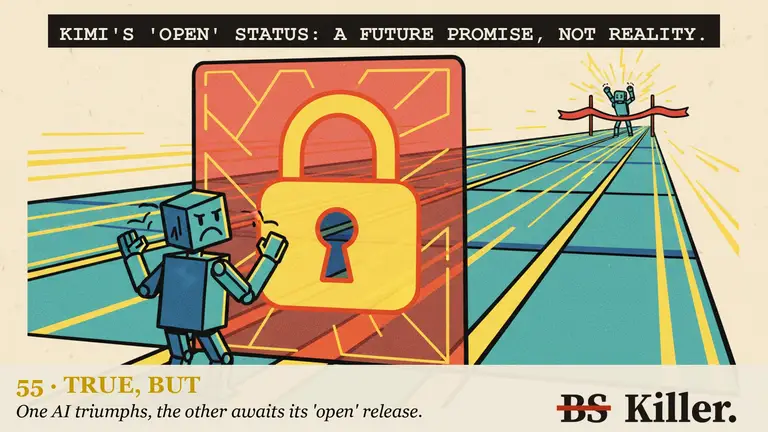
Open-source AI is a month behind the best, says the post going round. The model that closes the gap has no downloadable weights yet, and Artificial Analysis lists it as proprietary.
ModelCompare blog post (23 October 2026); trending on Hacker News and r/artificial 24 to 25 October 2026 ·
AI illustration
The 55 score is real and comes from Artificial Analysis. The 'month behind' is ModelCompare's own arithmetic, and it counts Kimi K3.1 Pro as open because Kimi promises weights by Nov 4.
Free with your account
Sign in for this free check.
This edition’s selected free story opens after sign-in.
Reading estimate: 650 words at 200 words per minute. Source quotes and the optional sections below add reading time.
Get tomorrow's check in your inbox.
One AI claim a night, checked against independent sources, receipts attached. Free.
At sign-up: 30 days free. Payment card required. One introductory trial per customer.
Your trial ends 30 days after you start. Unless you cancel before then in Account → Manage subscription, we charge A$89 for the first year. It renews automatically at A$89/yr until cancelled.
You can ask for a full refund within 14 days after any annual payment, renewals included, with no reason needed, by emailing hello@bskiller.com. This voluntary refund does not limit your rights under the Australian Consumer Law.