The trick: Moved Goalpost
OpenAI moved its own biorisk red line by 20 points and called the model that cleared it safe.
A safety threshold that says 50% one quarter and 30% the next is not a stricter bar, it is a bar that stopped holding still.
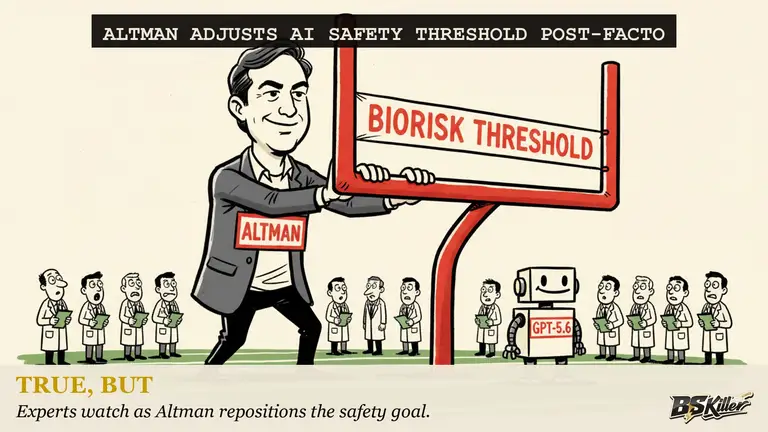
OpenAI's GPT-5.6 System Card states GPT-5.6 Sol scores below its indicative biorisk threshold for protein-binding capability, using '30% as an indicative threshold, based on a survey of 20 independent experts.'
Before you read on. Your call?
TRUE, BUT
20-point move
A safety threshold that says 50% one quarter and 30% the next is not a stricter bar, it is a bar that stopped holding still.
There’s more to this story.
Membership opens the full investigation, the strongest counterargument and what to do with what you’ve learned.
30 days free, then A$89 a year. Payment card required. Cancel before the trial ends to avoid the first charge.
Review my 30-day free trial →- At sign-up: 30 days free. Payment card required. One introductory trial per customer.
- Your trial ends 30 days after you start. Unless you cancel before then in Account → Manage subscription, we charge A$89 for the first year. It renews automatically at A$89/yr until cancelled.
- You can ask for a full refund within 14 days after any annual payment, renewals included, with no reason needed, by emailing hello@bskiller.com. This voluntary refund does not limit your rights under the Australian Consumer Law.
By starting your trial, you agree to the Terms.
BS Killer is published by Inferno Tech Pty Ltd, ABN 27 647 413 474.
Get tomorrow’s check free by email.
Couldn't check your access. That's on us.
The trick has a name
We call it Moved Goalpost: the threshold itself was changed, quietly. You'll see it again. Learn to spot it →
Receipts
- Refutes deploymentsafety.openai.com:
Accordingly, we propose 50% correctness as the threshold for biorisk concern.
- Supports deploymentsafety.openai.com:
August 19, 2026: We corrected GPT-5.5's pass@4 score on the hard-negative protein binding prediction evaluation from 0.4% to 1.48%.
- Context securebio.substack.com:
identifies an approach that successfully evades certain screening systems, but would be inconvenient for a malicious actor to carry out in practice
- Refutes arxiv.org:
The 2025 OpenAI Preparedness Framework does not guarantee any AI risk mitigation practices
- Supports kingy.ai:
OpenAI believes the family is capable enough in biological and chemical domains to trigger stronger safeguards.
Open the Receipts Pack → What each source proves, every figure traced, and what would change our verdict.