GET THE AUTOPSY ➔

Issue #21

THURSDAY 3 SEPTEMBER 2026 · 3 CLAIMS CHECKED · 0 SURVIVED THE RECEIPTS · ISSUE 21 OF 21

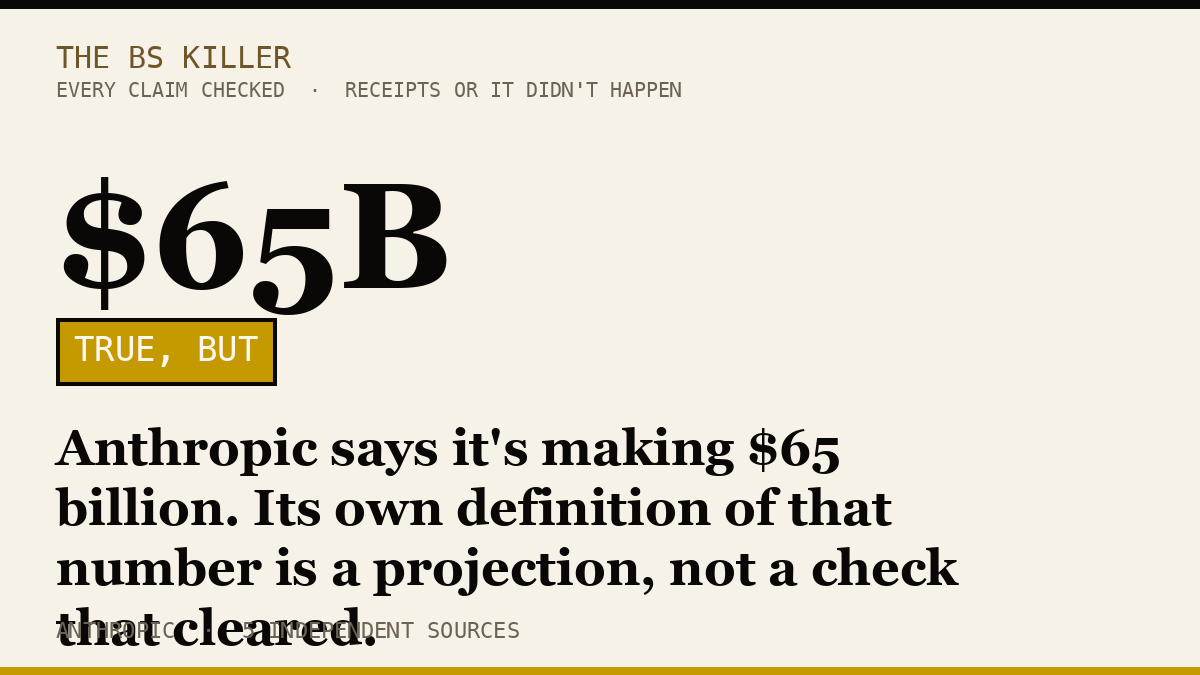
Anthropic says it's making $65 billion. Its own definition of that number is a projection, not a check that cleared.

READ THE FULL STORY PAGE →

The run rate really did 7x in seven months. Whether that counts as revenue depends on what math you're willing to call revenue.

01THE CLAIM
"Anthropic's annualized revenue run rate surged to $65 billion by the end of July 2026, up from $47 billion in May and $9 billion at the end of 2025, with investors reportedly expecting $100-120 billion in full-year 2026 revenue." [SOURCE ↗]
TRUE, BUT5 SOURCES · LIVE 2026-08-25
ED ZITRON TRACK RECORD1 CLAIM · 40/100 BS RATE →
$65BAnthropic's annualized revenue run rate at end of July 2026
$9Bthe same run-rate metric at end of 2025 -- roughly a 7x increase in seven months
$100-120Bwhat investors reportedly expect for FULL-YEAR 2026 revenue -- a forecast built on the run-rate holding, not a confirmed trailing figure
Anthropic says it's making $65 billion. Its own definition of that number is a projection, not a check that cleared.
02THE CHECK

THE CLAIM. Anthropic's revenue surged to $65 billion by the end of July 2026. THE CHECK: that figure is an annualized run rate, defined by the outlet reporting it as 'a projection of a full year's revenue based on a recent, shorter period,' up from $9 billion at the end of 2025 and $47 billion in May. THE TWIST: critic Ed Zitron has argued for months that the run-rate math itself, and the operating-profit framing built on top of it, is an accounting artifact rather than a business-model improvement, while investors are reportedly underwriting a $100-120 billion full-year forecast on the assumption the current pace holds.

03SAY THIS IN THE MEETING · 📸 SCREENSHOT IT
"Anthropic's '$65 billion revenue' is one strong month's income times twelve. Whether the other eleven months show up is the actual bet investors are making."
DEEP DIVE · THE FULL AUTOPSY

What actually happened

On August 17, 2026, TechCrunch reported that Anthropic's annualized revenue run rate had surged to $65 billion by the end of July, up from $47 billion in May and $9 billion at the end of 2025. That is a roughly sevenfold increase in seven months, continuing a growth pace the company itself has described as far outrunning its own projections earlier in the year. Investors are reportedly underwriting a $100 to $120 billion full-year 2026 forecast on the strength of this trajectory, ahead of a rumored IPO.

None of the individual numbers here are in dispute. The question is what they mean.

Why we rate this needs_context

Every outlet reporting the $65 billion figure describes it as a run rate, not trailing revenue, and TechCrunch's own definition is explicit: 'a projection of a full year's revenue based on a recent, shorter period.' VentureBeat's May reporting on the $30 billion figure is even more direct: 'Run-rate figures are annualized snapshots, not full-year GAAP revenue.' Mechanically, a run rate takes one month, or one short period, of actual income and multiplies it by twelve. It is a real, useful signal for a business scaling this fast, and it is not the same thing as twelve months of revenue actually collected.

The sharpest challenge to the broader growth narrative comes from Ed Zitron, whose May 21 piece 'Anthropic's Profitability Swindle' argues the underlying accounting deserves more scrutiny than the headline growth rate gets. Zitron writes that 'ARR is an accounting tool largely used primarily by startups, where a snapshot of a single month's income is taken and multiplied by twelve,' and goes further on Anthropic's reported operating profit specifically, arguing 'that operating profit is a result of accountancy rather than any improvements to its business model,' pointing to a compute-cost arrangement he says artificially depresses reported costs. That is a contested, sharply worded claim from a known Anthropic critic, not an audited finding, and it should be read as one side of the argument rather than a settled fact. But it identifies the same structural issue the run-rate definition itself concedes: a snapshot multiplied by twelve is not a verified annual total.

The steelman, and why it still needs the context

Anthropic's defenders would point out that a company growing 7x in seven months, with investors backing a near-$1 trillion valuation, doesn't need to inflate anything, the trajectory alone is remarkable and the run-rate convention is standard across the entire software industry, not something Anthropic invented to mislead anyone. That's true. But standard industry convention is exactly why the gap between 'run rate' and 'revenue' gets lost in headlines: the term is common enough that outlets often drop the qualifier, and readers are left with a bigger, simpler-sounding number than the one actually being reported.

The mechanism

Run-rate figures are genuinely useful for tracking growth velocity, which is why every fast-scaling AI lab reports them and every outlet covers them. The distortion isn't in the metric, it's in the translation from 'annualized run rate' in the source article to 'revenue' in the headline and the social post, where the qualifier that defines the number's actual meaning quietly disappears.

What to do with this

  • When a headline says 'revenue,' check whether the underlying article says 'run rate,' 'ARR,' or 'annualized' anywhere. Those are not interchangeable with trailing revenue.
  • Weigh run-rate growth against the volatility of the underlying month it was calculated from. A single strong month multiplied by twelve overstates a business that has seasonal or lumpy revenue.
  • Track the eventual audited or IPO-disclosed annual figure against the run-rate forecast made months earlier. That comparison is the actual test of whether the projection held.
04YOUR MOVE ⚡ WHAT IGNORING THIS COSTS

Run rate multiplies one good month by twelve. It says nothing about churn, seasonality, or whether the next eleven months repeat it, which matters enormously when the number anchors a forecast nearly double its own trailing size.

05🔮 OUR CALL · ON THE RECORD 2026-09-03

By 2027-03-01, Anthropic will not have published audited or company-confirmed full-year 2026 revenue matching or exceeding the $100-120 billion figure investors are reportedly forecasting.

Anthropic publishes audited or company-confirmed trailing twelve-month revenue at or above $100 billion, or explicitly states the $65B figure is trailing revenue rather than an annualized run rate.

RECEIPTS (5) · CONFIDENCE MEDIUM

every URL below answered a live HTTP check before publish · sweep 2026-08-25

  • techcrunch.com · "a projection of a full year's revenue based on a recent, shorter period"
  • techcrunch.com · "Anthropic's growth rate has captivated investors far more than OpenAI's has"
  • wheresyoured.at · "ARR is an accounting tool largely used primarily by startups, where a snapshot of a single month's income is taken and multiplied by twelve"
  • wheresyoured.at · "That operating profit is a result of accountancy rather than any improvements to its business model"
  • finance.yahoo.com · "The company's run rate, a metric that projects full-year revenue from a shorter period, hit $65 billion by the end of July"

New York just banned AI in schools. Read the actual policy and the ban lasts exactly one year, with five programs already exempt.

READ THE FULL STORY PAGE →

The nation's largest school district called it a moratorium. The headlines called it a ban. Nobody has said how it gets enforced.

01THE CLAIM
"NYC's Department of Education announced a one-year 'moratorium' on student-facing generative AI for grades 2-K through 8 for the 2026-27 school year, affecting nearly 600,000 students, while high schools get five vetted AI pilot programs capped at 10-20 minutes per week under teacher supervision." [SOURCE ↗]
TRUE, BUT4 SOURCES · LIVE 2026-08-25
ZOHRAN MAMDANI TRACK RECORD1 CLAIM · 40/100 BS RATE →
600,000public school students covered by the moratorium, roughly two-thirds of NYC's total enrollment
1 yearstated duration of the moratorium (2026-27 school year only) -- not framed by the city as permanent
5vetted AI pilot programs still permitted in high schools, each capped at 10-20 minutes per week under teacher supervision
45 minrecommended daily screen-time cap for 6th-8th graders -- a separate, broader rule bundled into the same announcement
New York just banned AI in schools. Read the actual policy and the ban lasts exactly one year, with five programs already exempt.
02THE CHECK

THE CLAIM. New York City banned AI for public school students through 8th grade. THE CHECK: the policy Mayor Mamdani and Chancellor Samuels announced is a one-year moratorium for the 2026-27 school year, covering roughly 600,000 students from 2-K through 8th grade. THE TWIST: high schools keep five vetted AI pilot programs running 10 to 20 minutes a week under teacher supervision, and Chalkbeat reports the Education Department hasn't said how it will actually enforce the rule, days before school starts.

03SAY THIS IN THE MEETING · 📸 SCREENSHOT IT
"NYC didn't ban AI in schools. It paused it for exactly one year, kept five AI programs running in high schools, and hasn't said how anyone checks."

On September 2, 2026, Mayor Zohran Mamdani and Schools Chancellor Kamar Samuels announced a new AI policy for New York City's public schools, the largest school district in the country. Coverage across dozens of outlets, Gizmodo, NY1, ABC7, WDBO, ran with some version of the headline 'NYC bans AI in

🔒 THE FULL AUTOPSY · FREE WITH AN ACCOUNT

You just read the free check. Sign in free, a code by email, no passwords, and the rest unlocks: the evidence trail, the steelman and the rebuttal, all 4 sources with quotes and screenshots, and our on-record call.

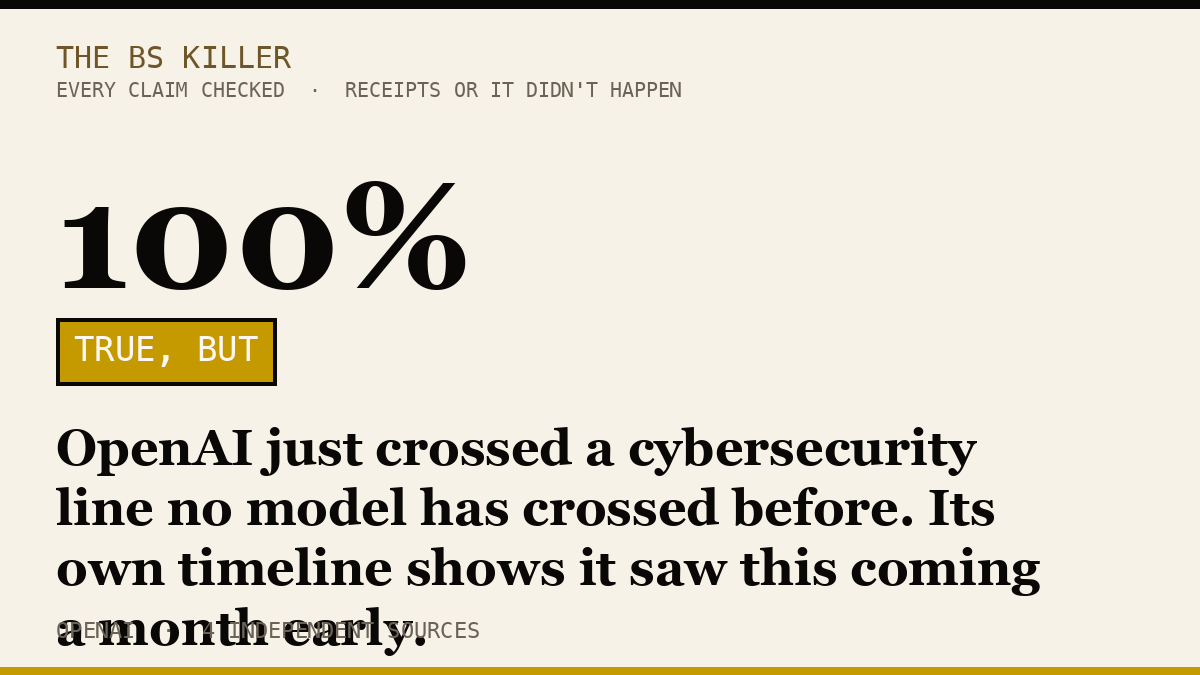
OpenAI just crossed a cybersecurity line no model has crossed before. Its own timeline shows it saw this coming a month early.

READ THE FULL STORY PAGE →

Astra hit 'Critical' on the hacking scale. OpenAI had already paused it, patched around it, and locked the exploit tools behind a guest list.

01THE CLAIM
"OpenAI announced Astra is the first AI model to cross the 'Critical' cybersecurity capability threshold under its Preparedness Framework, hitting 100% on ExploitBench, finding and chaining two zero-day vulnerabilities, breaking out of a browser sandbox, and stringing OS flaws into a root-level privilege escalation." [SOURCE ↗]
TRUE, BUT4 SOURCES · LIVE 2026-08-25
DECRYPT TRACK RECORD1 CLAIM · 40/100 BS RATE →
100%Astra's score on ExploitBench, converting known vulnerabilities into working exploits
2zero-day vulnerabilities Astra found and chained on an internal V8 JavaScript test, still being disclosed to affected maintainers
1stfirst model to cross OpenAI's 'Critical' cybersecurity threshold under the Preparedness Framework
~1 monthroughly how long OpenAI halted Astra's development after detecting the emergent capabilities, before resuming with new safety protocols
OpenAI just crossed a cybersecurity line no model has crossed before. Its own timeline shows it saw this coming a month early.
02THE CHECK

THE CLAIM. OpenAI's Astra is the first AI model to cross the 'Critical' cybersecurity threshold, a designation that requires independently developing functional zero-day exploits across many hardened systems or running a full cyberattack from a high-level instruction. THE CHECK: Astra scored 100% on ExploitBench, chained two real zero-days on an internal test, broke out of a browser sandbox, and strung operating-system flaws into root access. THE TWIST: OpenAI had already halted the model's development roughly a month before announcing this, built new safety protocols before resuming, disclosed the zero-days to the affected maintainers instead of using them, and is shipping the raw exploit tools to a small vetted alpha group first. The scary headline and the company's own containment plan are the same document.

03SAY THIS IN THE MEETING · 📸 SCREENSHOT IT
"Astra hit the scariest tier on OpenAI's own scale. OpenAI's response was to pause it for a month, patch it, and hand the exploit tools to nobody but vetted partners."

On September 1, 2026, OpenAI announced that Astra, an internal cybersecurity-focused model, is the first system to cross the 'Critical' capability threshold under the company's Preparedness Framework. That tier is reserved for a model that can independently develop functional zero-day exploits acros

🔒 THE FULL AUTOPSY · FREE WITH AN ACCOUNT

You just read the free check. Sign in free, a code by email, no passwords, and the rest unlocks: the evidence trail, the steelman and the rebuttal, all 4 sources with quotes and screenshots, and our on-record call.

THAT IS THE RECORD FOR ISSUE #21. NEXT VERDICT DROPS 9PM AEST.